Great Migration Safari
The great wildebeest migration is not a single event but a year-long, rain-driven circuit across the Serengeti–Mara ecosystem. A great migration safari begins with a choice of where to be in the month you travel, with room built in for the herds to move. River crossings are never assured.
Roqueni & Co. shapes these journeys as tailor-made and private. For the wider country, see Tanzania.
What the migration is
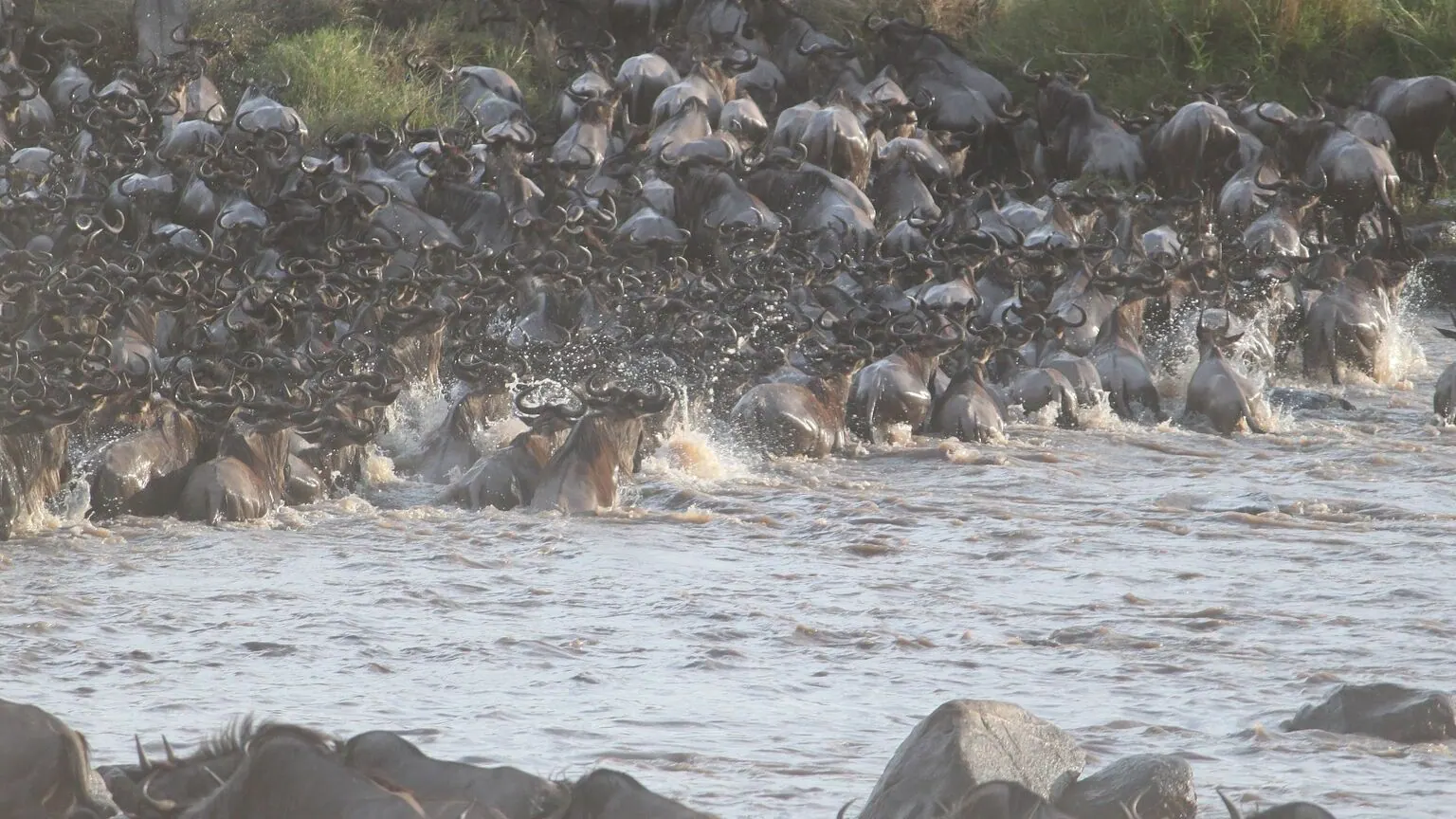
UNESCO describes the Serengeti's wildebeest migration as the "largest remaining unaltered animal migration": over a million wildebeest, joined by hundreds of thousands of other grazing animals, on a circuit of about 1,000 km between Tanzania and Kenya.
According to UNESCO, Serengeti National Park is the core of a larger cross-border ecosystem that also takes in part of the Ngorongoro Conservation Area, Maswa, Grumeti, Ikorongo, Loliondo and Kenya's Maasai Mara National Reserve. A 2024 UNESCO and IUCN mission describes the movement as continuous and clockwise, driven by rainfall and fresh grazing.
The Ngorongoro Conservation Area Authority places the Ndutu plains inside the Conservation Area, on the edge of the southern Serengeti plains, and names them a calving ground for the migration. Kenya's Maasai Mara is on UNESCO's Tentative List and is not inscribed as a World Heritage site.
Counts differ. A 2023 aerial survey by the Tanzania Wildlife Research Institute estimated about 1.37 million migratory wildebeest, while Oxford-led satellite counts of Mara imagery came in substantially lower.
The Maasai Mara management plan also records a smaller Loita migration that stays within Kenya and mixes with the larger herds in the Mara, typically from about July to September. For the Kenyan side, see Masai Mara.
Where the herds often are, month by month
| Months (typical) | Where herds often gather | What to expect |
|---|---|---|
| End of December–April at Ndutu (Ngorongoro Conservation Area Authority), calving often peaking in February | Southern short-grass plains and Ndutu | Calving and predator activity |
| April–May | Moving north-west through the central Serengeti | Long rains, green landscapes, fewer visitors |
| May–July, especially June–July | Western Corridor, along the Grumeti and Mbalageti rivers | Grumeti crossings, usually smaller; quieter than the north |
| July–October | Northern Serengeti and Kenya's Maasai Mara | Mara River crossings |
| October–November | Returning south through the northern, central and eastern Serengeti | Late crossings; short rains |
| November–December | Arriving back on the southern plains | Gathering before calving |
Read these months as ranges, not dates:
- Timing shifts with the rains each year.
- The herds split and spread, so the migration is often in several places at once.
- River crossings do not happen every day and are not assured, even in the busiest months.
The Tanzania National Parks Authority points to January–February for calving and June–October for the migration in the Serengeti. The Ngorongoro Conservation Area Authority describes the herds at Ndutu from the end of December until April, and Kenya's tourism board gives about July to October for the Mara. Where the herds are not, resident wildlife remains: the Ngorongoro Conservation Area Authority states that Ndutu is good for resident game such as elephant, lion, cheetah, hyena and giraffe year-round.
Routing a journey by month
End of December–April: the southern plains. The Ngorongoro Conservation Area Authority places the herds at Ndutu from the end of December until April. Base the journey around Ndutu and the southern Serengeti, and pair it with the Ngorongoro highlands and Tarangire. Mwiba Lodge, on a private reserve south of the Serengeti, states that it is positioned for calving-season access from December to early March.
May–July: the Western Corridor. Look at the Grumeti concessions in the west. Singita states that the Grumeti reserve was created in 1994 to protect the migration's path.
July–October: the north. Stay in the northern Serengeti, reached by light aircraft to the Kogatende and Lamai airstrips, in the Kenyan Mara conservancies, or split time between both. Plan Kenya and Tanzania entry separately, and fly between them through Arusha or Kilimanjaro and Nairobi.
All year: staying flexible. Some camps move with the herds; Nomad, for one, states that its Serengeti Safari Camp crew is "on the move year-in, year-out … guided by the mass movements of the wildebeest migration." Confirm each camp's location for your dates when planning.
Stays that show the range
- Mobile migration camp — Nomad Serengeti Safari Camp.
- Permanent camp in the north — Asilia Sayari.
- Western private concession — Singita Grumeti.
- Southern private reserve — Mwiba Lodge.
Confirm opening dates and location for each camp before you book. For the full range of high-end stays, see Tanzania luxury safaris.
Watching responsibly
Crowding at crossings. Kenya's Maasai Mara management plan records more than 150 vehicles at times at a single Mara River crossing, and sets out actions to manage crossings.
Quieter sectors. A study of Serengeti visitor numbers found that about 64% of the park's accommodation sits in Seronera and hosts about 84% of visitors, while migrating herds spent less time there than at Ndutu or Kogatende. For the park's sectors in depth, see Serengeti.
Conduct in the park. Tanzania National Parks Authority rules forbid off-road driving unless explicitly permitted and require visitors to keep to gate times. Serengeti National Park is not on the Authority's list of parks that permit night drives.
Journey shapes
- The calving chapter: Ndutu and the southern Serengeti, then the Ngorongoro highlands.
- The Western Corridor in a quieter season.
- The northern crossing window, with several nights at one flexible base.
- Tanzania and the Kenyan Mara, split between the two sides.
- The migration within a wider luxury journey; see Private African Safaris.
- A safari followed by a beach or honeymoon chapter; see safari honeymoons.
For the broader picture, see African Safaris.
Practicalities
Gateways. Journeys usually begin through Kilimanjaro or Arusha, and light aircraft serve the Serengeti airstrips, including Kogatende and Lamai in the north. Schedules change, so confirm each flight at booking.
Luggage. Limits are set by each air operator; confirm the limit for every flight at booking.
Two authorities. Ndutu falls under the Ngorongoro Conservation Area Authority and Serengeti National Park under the Tanzania National Parks Authority, and each sets its own fees. Ask for current fees from each authority when planning.
Conservation
UNESCO and IUCN describe the migration as driven by rainfall and grazing, across an ecosystem shared by Tanzania and Kenya. Kenya's Maasai Mara management plan sets out actions to manage crowding at river crossings. Where you can, choose quieter sectors and months.
FAQ
- When is the best time for a Great Migration safari?
- It depends on what you want to see. Calving on the southern plains and Ndutu typically falls between December and March, often peaking in February, though the Ngorongoro Conservation Area Authority describes the herds at Ndutu from the end of December until April and the Tanzania National Parks Authority points to January–February; Mara River crossings typically fall between July and October. Timing shifts with the rains each year.
- Can you guarantee a river crossing?
- No. Crossings do not happen every day and cannot be predicted, even in the busiest months. Plan several nights at one base near the river.
- Is the migration in Kenya or Tanzania?
- Both. Kenya's tourism board calendar puts the herds in the Mara for about four months, July to October, with the rest of the circuit in Tanzania.
- Where do the herds calve?
- On the southern short-grass plains and at Ndutu, which the Ngorongoro Conservation Area Authority names as a calving ground. The Authority describes the herds there from the end of December until April; calving often peaks around February, and the timing varies with the rains.
- How many wildebeest are there?
- UNESCO puts the number at over a million. A 2023 Tanzanian aerial survey estimated about 1.37 million, while Oxford-led satellite counts came in substantially lower.
- Is it crowded at the crossings?
- It can be. Kenya's Maasai Mara management plan records more than 150 vehicles at times at a single crossing. In Tanzania, a study found most visitors concentrated around Seronera, where migrating herds spent less time than at Ndutu or Kogatende.
- What park fees apply?
- The Tanzania National Parks Authority sets fees for Serengeti National Park, and the Ngorongoro Conservation Area Authority sets fees for Ndutu. Ask for current fees from each when planning.
Whether you picture calving on the southern plains, the quieter Western Corridor or the northern rivers, the next step is a conversation about month, place and pace.